
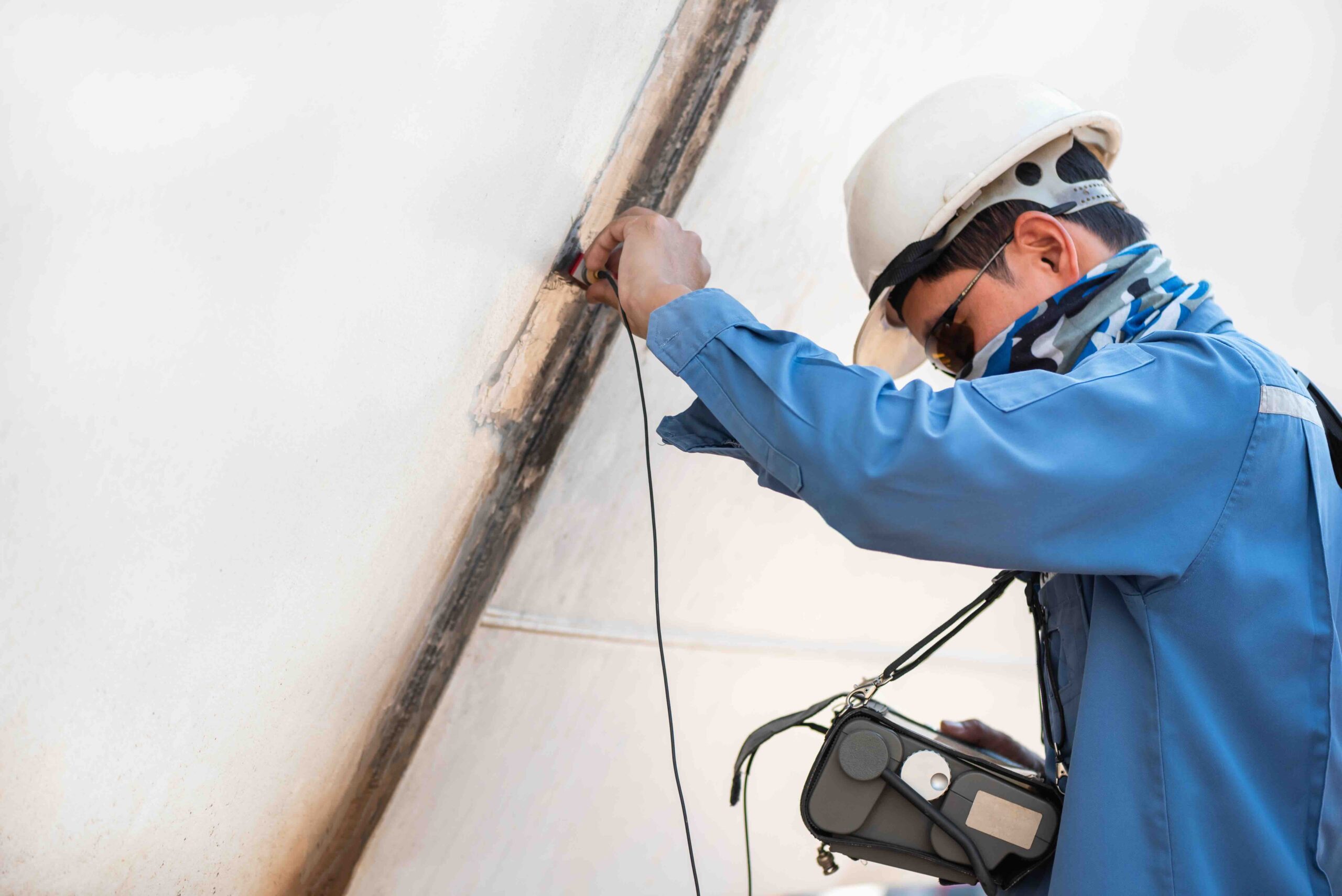
Acoustic measurements are generally quantified using decibels. But decibels measure sound levels or the perception of sound by the human ear. They don’t measure privacy. Similarly, there are other qualities that clients might want measured. For example, the efficacy of our system, or the measurable quantity of improvement for speech privacy.
Quantifying sound masking performance
Most of the time, customer satisfaction is how we measure the success of a Soundmask system. Does the system solve the client’s problem? Is the client happy with the result? And have we improved the acoustic environment for the end users?
Satisfying each of these questions with a “yes” is the base level requirement for any Soundmask system. But sometimes that’s not enough. Acoustic consultants might have specific ratings or requirements they need to meet. Indeed there are various standards and curves involved!
STC, Dw, and PF
The above acronyms, and a few others, are sometimes used in specifications or other documents that we receive. Sometimes clients will request specific measures of improvement to make a business case for management. But what do each of these mean? And can they measure privacy?
Sound Transmission Class
Sound Transmission Class (STC) is a sound insulation criteria which is often used to measure sound transmission through or around walls (eg, thin walls, or gaps). There may be a building standard, or use of the ISO 717-2:2020 Acoustics — Rating of sound insulation in buildings and of building elements standard. Perhaps the field-tested sound insulation ratings (FSTC) must be greater than or equal to 5 dB below the specified design STC rating for the tested partition.
If the fitout fails to meet this measurement, a Soundmask system is often the only option — all others have been exhausted. Sound masking itself would not have an STC because it is not sound insulation. However, it can improve the measurement where the walls, glazing and other measures do not meet the criteria. For example in the table below, the walls, doors, and glazing didn’t achieve the criteria.
| Path | STC Criteria | Composite STC Criteria | FSTC Criteria | FSTC | Achieves Criteria? |
| From Corridor to Mtg Room 1 | STC 50 Wall, STC 35 Door | 38 | 33 | 28 | No |
| From Board room to Corridor | STC 55 Wall, STC 45 Door | 55 | 50 | 44 | No |
| From Reception to Board Room 1 | STC 55 Door and Glazing | 48 | 43 | 41 | No |
Here, we added masking to ensure the fit out achieved the criteria.
Weighted normalised difference
Dw or “weighted normalised difference” measures the difference between the sound levels in one space compared to another. For example, you may have a confidential interview taking place in the interview room, and in the corridor, you can hear it. The Dw measurement will be the interview room sound levels minus the corridor sound levels. The higher the Dw, the less sound is being transmitted, and the better the speech privacy. We might be asked to install a Soundmask system to improve the Dw that has the issues like those in the table below.
| Source Room | Receiver Room | Criteria Dw | Sound Insulation Dw | Compliance |
| Interview Room | Corridor | 35 | 25 | No |
| Interview Room | Meeting Room | 35 | 25 | No |
| Interview Room | Reception | 35 | 27 | No |
This reveals that either the sound insulation needs to be improved, or the sound levels need to be increased. But that’s not all.
Privacy Factor (or Privacy Index)
Another measurement is the Privacy Factor or Index which can be measured between 0 or 100. Generally, a PF of 75-80 will ensure sound is audible and just intelligible, but not intrusive in the adjacent space. Whereas 80-85 means speech is no longer intelligible. Usually a PF of 80+ is preferred for speech privacy.
The calculation is a simple equation that adds the Dw value with the LAeq. But it is not always a precise calculation.
For example, in the table above, where the Sound Insulation Dw of 27, you would need to add LAeq of 53 to meet the required privacy factor of 80. That is a very high volume of sound, and is generally not necessary even in the quietest settings. So there is some flexibility.
Is there a generic measure?
It’s possible to provide a measurement in a table, based upon an average fit out. For example, the following tables illustrate the impact a Soundmask system has made in the past. It uses the AS/NZS 2107:2016 Recommended Internal Noise Levels to improve the privacy factor in each room.
BEFORE SOUND MASKING INSTALLED
| Room | Criteria LAeq (dBA) | Measured Internal Level LAeq (dbA) | Compliance? |
| Quiet Room | 35-40 | 28 | No |
| Meeting Room 1 | 40-45 | 25 | No |
| Meeting Room 2 | 40-45 | 27 | No |
AFTER SOUND MASKING INSTALLED
| Room | Criteria LAeq (dBA) | Measured Internal Level LAeq (dBA) | Compliance? |
| Quiet Room | 35-40 | 36 | Yes |
| Meeting Room 1 | 40-45 | 40 | Yes |
| Meeting Room 2 | 40-45 | 40 | Yes |
The trouble with the above tables is that it was specific to the job. It would only be accurate where the exact same conditions were set as a base. This is because where measurements are involved, generally a Soundmask system will be included after the existing conditions fail to meet a particular criteria. (Or are expected to, in the case of a new build).
Sound masking is used to improve the acoustic environment. In the example above, a Soundmask system was used throughout to provide a higher background sound level which reduced sound transmission between the sensitive rooms.
And while a Soundmask system could achieve anywhere within the criteria range, we tend to set the levels at a comfortable volume (often at the lowest end, or below).
So how do we measure privacy?
There are various ways to measure privacy, and each has its own use. But ultimately, aside from subjective user experience, the measurement used to quantify sound masking is in decibels (with an A-weighting – dBA).
Do you have speech privacy or sound transmission problems in your space? Please contact us for help.